Drinking more water is not the same thing as staying hydrated — and during a severe heatwave, that difference can put you in an emergency room. This piece walks through the mineral math behind cellular hydration, why plain water in volume can trigger hyponatremia, and two low-tech cooling techniques (pulse-point compresses and sleep environment control) that do more than a blasting AC unit ever will. None of it requires new gear. Most of it requires paying attention to signals you’ve been trained to ignore.
I was on my fourth glass of water before noon, refilling the same chipped mug at the kitchen sink, and my hands had gone slightly numb. Not dramatic. Just wrong, in a way I couldn’t place. I remember thinking, stupidly, that I just needed more water. I did not. I needed salt.
That’s the trap. When it’s 41°C outside and your skin is doing everything it can to cool you down, the instinct is to flood the system. But your body isn’t a bucket. It’s a gradient — and gradients need minerals to move water across them, not just volume.
When plain water triggers hyponatremia during extreme heat exposure
Here’s the part nobody explains clearly enough: sweat isn’t just water leaving your body. It’s water and sodium leaving your body, roughly 40–60 mmol of sodium per liter depending on your acclimatization and how hard you’re working. If you replace only the water and skip the sodium, your blood sodium concentration drops. Drop it far enough — below about 135 mmol/L — and you’re in exercise-associated hyponatremia territory, which starts as nausea and confusion and, in the ugly cases, ends in seizure.
This is not a fringe risk. It’s disproportionately common in people who are trying to do the right thing — marathon runners, outdoor laborers, people over-correcting for a heat warning by chugging bottle after bottle of plain water with nothing in it. The dilution happens quietly. You don’t feel “too much water” the way you feel dehydration. You just feel foggier, then worse.
(I want to be honest: I was skeptical of this the first time a sports physiologist explained it to me. It sounded like a technicality. It is not a technicality.)
Water-Only Intake Over 1L/Hour, Sustained | Mechanism: Plasma sodium concentration falls faster than kidneys can excrete the excess free water, diluting extracellular fluid and triggering cellular swelling — most dangerous in brain tissue, which has limited room to expand.
Thirst as Sole Hydration Signal | Mechanism: Thirst lags true fluid deficit by 1–2%, meaning by the time you feel thirsty you’re already mildly dehydrated — but during heavy heat exposure, thirst can also persist after adequate intake, which is why it’s an unreliable solo metric either direction.
For rehydration that actually reaches the cell, not just the stomach
The fix isn’t complicated, but it is specific. Water alone moves across your gut wall slowly and inconsistently. Add sodium and a small amount of glucose, and you activate something called the sodium-glucose cotransporter (SGLT1) in the small intestine — a transport protein that pulls sodium and glucose across the intestinal wall together, and water follows passively behind them, pulled by the resulting osmotic gradient. It’s mechanical, not mystical. Salt and sugar, in the right ratio, drag water into your bloodstream faster than water does on its own.
This is why oral rehydration solutions — the ones developed originally for cholera patients losing catastrophic fluid volumes — outperform plain water for actual rehydration speed, not just hydration feeling. The World Health Organization’s standard formula runs close to 75 mmol/L sodium and 75 mmol/L glucose. You don’t need to hit that exactly at home. You need the general shape of it.
Sodium isn’t the only mineral doing work here, though it’s the headline one:
Sodium (Na+), roughly 1,000–1,500mg replaced per liter of sweat lost in heavy exposure | Mechanism: Maintains extracellular fluid volume and the electrical gradient nerves and muscles depend on; deficiency causes the cramping, confusion, and swelling associated with hyponatremia.
Potassium (K+), smaller replacement volume, roughly 200–300mg per liter | Mechanism: Governs intracellular fluid balance — the water inside your cells, as opposed to sodium’s role outside them — and supports normal heart rhythm, which is part of why severe deficiency shows up as arrhythmia before anything else.
Magnesium (Mg2+), often overlooked, roughly 10–20mg per liter | Mechanism: Cofactor in over 300 enzymatic reactions including ATP production and muscle relaxation; low magnesium during heavy sweat loss is a likely (if under-discussed) contributor to nighttime leg cramps in hot weather.
A pinch of salt and a spoon of honey in a liter of water gets you most of the way there. I know that sounds almost insultingly simple after all the biochemistry above. It is simple. That’s sort of the point — the mechanism is complex, the application isn’t.
For cooling arterial pulse points to drop core body temperature
Air conditioning cools the room. It doesn’t directly cool you, not in the fast, targeted way your own circulatory system can, if you help it along.
Certain points on your body carry blood close to the surface, close enough that cooling the skin there cools the blood moving underneath — and that cooled blood then circulates back toward your core. The carotid artery in your neck is the most efficient of these. Your wrists (radial artery), the inside of your elbows, behind your knees, and your ankles are the secondary sites, all places where a major vessel runs shallow.
Cold compress or ice pack, wrapped, held on the carotid pulse point (side of neck) for 3–5 minutes | Mechanism: Blood in the carotid artery is en route directly to the brain and returns via the jugular; cooling it here has an outsized effect on perceived core temperature relative to compress size, likely due to hypothalamic thermoregulatory sensitivity in that region.
Cold water immersion of wrists and forearms, 30–60 seconds, repeated | Mechanism: The radial and ulnar arteries sit close to skin here with minimal fat insulation, making this one of the fastest accessible cooling sites for sustained heat exposure — often used in occupational heat-stress protocols for outdoor workers.
Damp cloth behind the knees and inner elbows during rest periods | Mechanism: Secondary pulse points with slower but still meaningful thermal exchange; useful as a maintenance technique between more active cooling interventions rather than a first response.
I keep a small stack of washcloths in the freezer now, in a produce bag, which felt excessive when I set it up and has not felt excessive a single time since.
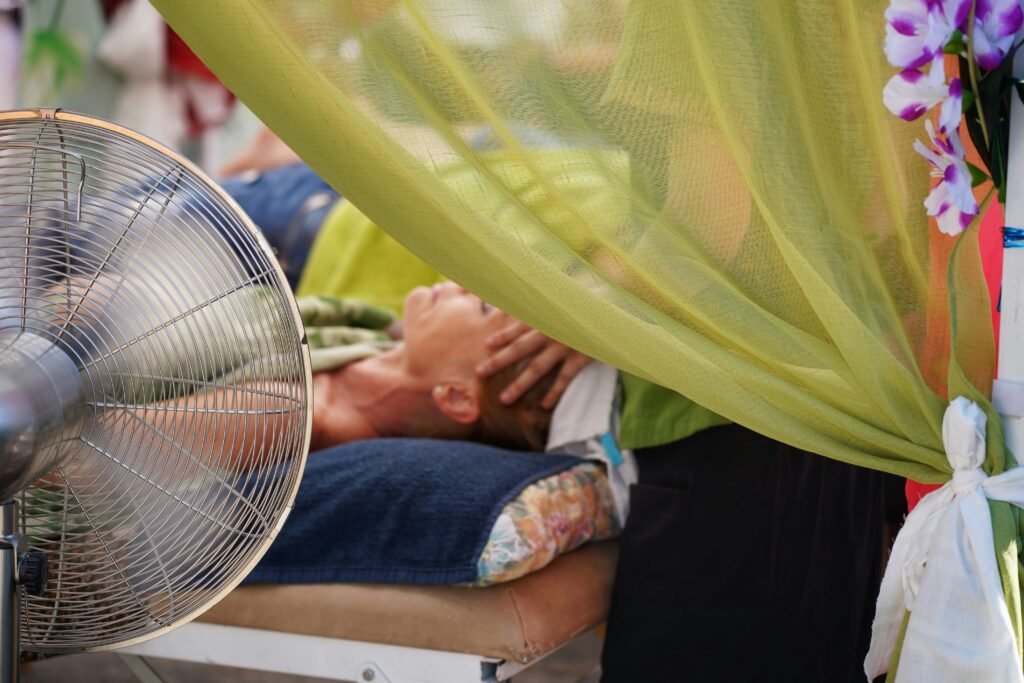
When the bedroom becomes the hardest part of the day to survive
Nobody talks about this enough: heatwaves are often worse at night than the daytime numbers suggest, because your body needs a drop of roughly 1°C in core temperature to initiate and sustain sleep, and a hot bedroom simply won’t let that happen. You lie there. You don’t sleep. The heat compounds the next day’s exposure because you’re starting it already depleted — which, in fairness, took me an embarrassingly long time to connect to why I felt worse on day three of a heatwave than day one.
Bedroom air temperature target, 18–20°C | Mechanism: Matches the core temperature drop needed to trigger and maintain sleep onset; above roughly 24°C, sleep architecture measurably fragments, with reduced deep and REM sleep.
Pre-sleep lukewarm (not cold) shower, 10–15 minutes before bed | Mechanism: Counterintuitively, lukewarm water dilates surface blood vessels, which then radiate heat once you’re out of the water and drying — accelerating the natural core temperature drop rather than shocking the body with cold, which can trigger vasoconstriction and trap heat instead.
Damp sheet or cooling towel on shins and feet overnight | Mechanism: Feet and lower legs are a primary site of vasodilation during sleep-onset thermoregulation; cooling this zone specifically supports the body’s own heat-dumping mechanism rather than fighting it.
I didn’t do any of this consistently for the first two weeks of the summer, and I paid for it in the kind of tired that doesn’t go away with coffee.
Staying Ahead of the Next Heatwave, Not Just Surviving This One
Editor’s Note: The wellness industry’s answer to heat is usually a product — a cooling mist, a fan, a $40 electrolyte tablet with more marketing than magnesium in it. My honest take, after several summers of getting this wrong: the electrolyte ratio matters more than the brand, the pulse points matter more than the room temperature, and most people are over-hydrating on water while under-hydrating on everything else. Fix the ratio before you fix the gear.
How to apply this, by situation:
- Electrolyte balance: If you’re sweating heavily for more than an hour, don’t reach for plain water alone — add a pinch of salt and a small amount of sugar or fruit juice to at least every second bottle.
- Pulse-point cooling: Keep a damp cloth or small ice pack in the freezer specifically for the side of your neck, not general use — grab it the moment you feel your face flush or your thinking go slightly slow.
- Sleep environment: Set the room cooler than feels necessary before you get in bed, not after — the temperature drop has to happen before sleep onset, not during it, to actually help.
- Warning signs to stop and reassess: confusion, puffy hands or face, nausea after drinking water specifically (as opposed to before) — these point toward dilution, not dehydration, and calling a step back is the right move, not an overreaction.
This article is written for general heat-safety awareness and is not a substitute for medical guidance — if you or someone near you shows signs of heat stroke or severe hyponatremia (confusion, seizure, loss of consciousness), that’s an emergency room situation, not a home-remedy one.
Leave a Reply