This is not a guide about clearing your mind — that was never really the point, and chasing it is why most people quit after four days. It’s about noticing you’re making a grocery list in your head, again, and gently coming back to your breath without treating it as a failure. We tested three of the most-used apps for beginners, timed the sessions against an actual Tuesday, and wrote down what stuck. Five minutes, done badly but done daily, beats twenty minutes done once and never again.
I was three minutes into what was supposed to be a five-minute sit when I realized I’d been silently rehearsing what to say to my landlord about the leaking tap. Not once. Twice. The timer hadn’t even gone off. This is, apparently, completely normal, and nobody tells you that on the app’s welcome screen.

The “clear your mind” advice was always going to fail you
Here’s the thing nobody says out loud in the beginner tutorials: you were never supposed to have an empty head. Neuroscientists who study meditation — real ones, not app copywriters — talk about the brain’s default mode network, the part that lights up when you’re not focused on a task, generating memories, plans, worries, tap-related landlord monologues. It doesn’t switch off because you sat down on a cushion. It doesn’t even switch off for people who’ve been doing this for twenty years.
What changes with practice isn’t the presence of thoughts. It’s your relationship to them. You notice a thought has shown up (there’s the landlord again), you name it without much drama — “thinking,” some teachers suggest, just that one flat word — and you walk attention back to the breath. That’s the whole rep. Not the absence of thought. The return.
I used to think I was bad at meditation because my mind wandered so much. Turns out the wandering-and-returning is meditation. The instructions I’d been half-reading skipped that part, or maybe I skipped it, skimming for the shortcut like I always do.
Building a five-minute habit that doesn’t collapse by Thursday
Five minutes sounds almost insultingly small when wellness culture keeps insisting on hour-long retreats and pre-dawn rituals. Good. Insultingly small is exactly the size that survives a real week.
The research on habit formation (James Clear’s Atomic Habits popularized this, though the underlying behavioral science is older) keeps landing on the same point: consistency beats intensity, especially at the start. A five-minute sit done seven days running rewires the habit loop faster than a single 45-minute session that leaves you sore and reluctant to repeat it. Small, dumb, repeatable — that’s the actual engine.
A few situational anchors that worked better for me than any fixed time slot:
When you’re already sitting down anyway — right after you set your coffee down, before you pick up your phone. The coffee becomes the trigger. You don’t need a new time in your calendar; you need to hook onto a moment that already exists.
When your thoughts won’t stop looping mid-task — this is less a scheduled sit and more an emergency valve. Ninety seconds, eyes closed, hand on the desk, three slow exhales longer than the inhales. Not a full session. A pressure release.
When you can’t fall asleep and know exactly why — the mind rehearsing tomorrow’s meeting for the ninth time. Different tool for this one, more on that below.
Missing a day, by the way, is not the end of the habit. I missed six days once, mid-move, boxes everywhere, and just started again on day seven without the whole “I’ve ruined it” spiral. The habit tolerates gaps. It doesn’t tolerate guilt turning into avoidance.
Choosing an app without falling into research paralysis
There are, by some counts, over two thousand meditation apps. Nobody needs to compare two thousand meditation apps. For a beginner in 2026, three cover almost every practical need, and each does one thing distinctly well rather than everything adequately.
Headspace — Structured Beginner Courses | Best for people who want to be told exactly what to do next Headspace’s real strength isn’t the animation style, though that’s what gets remembered. It’s the sequencing — a “Basics” course that stacks day on day, each session referencing what you learned in the last one, so you’re not starting from zero every single sit. If you’re the type who needs a syllabus rather than a blank page, this removes the decision fatigue entirely. You open the app, it tells you what today’s five minutes covers, you sit.
Calm — Ambient Soundscapes & Sleep Stories | Best for winding a racing mind down at night Calm leans into atmosphere over instruction — rain on a tin roof, a low voice reading a story about nothing in particular, designed to be mildly boring in exactly the right way. It’s less useful if you want structured technique-building during the day, and more useful as the nine-p.m. tool for the mind that won’t stop rehearsing tomorrow. I was skeptical of the sleep stories at first, genuinely thought it was a gimmick, and then fell asleep during one about a train through the Scottish Highlands and never finished it, which I suppose is the point.
Insight Timer — Extensive Free Library | Best for beginners on a budget or those who like choosing their own teacher Insight Timer’s library runs into the tens of thousands of free sessions, taught by a huge range of teachers, which is either liberating or overwhelming depending on your relationship with too many options. The free tier is genuinely generous, unusually so for this category, which matters if the cost of Headspace or Calm’s subscription is the thing standing between you and starting at all. The tradeoff: no built-in course logic, so you’re curating your own path, which is more work up front.
None of these is objectively “the best.” Headspace if you want a teacher. Calm if you want a room to fall asleep in. Insight Timer if you want a library card. Try one for a week before comparing — the differences matter less on paper than they do at 7 a.m. with your eyes half open.
When stray thoughts disrupt your five-minute sitting
This is the part that actually matters, so it gets its own section rather than a bullet point buried somewhere.
You’ll be sitting. A thought will show up — an email you forgot to send, a text you should reply to, whether you left the stove on (you didn’t, you never do, but the thought insists). The beginner instinct is to fight it, shove it away, feel like you’ve failed the exercise. Don’t. Instead:
- Notice the thought arrived. That’s it, that’s the whole first step, just noticing.
- Label it loosely if it helps — “planning,” “worrying,” “remembering” — without unpacking the content further.
- Bring attention back to a physical anchor: the breath at the nostrils, the rise and fall of the chest, the weight of your feet on the floor.
- Expect to do this eight, ten, fifteen times in a single five-minute sit. That’s not a bad session. That’s a completely average one.
I still, more than a year in, spend a meaningful chunk of most sits thinking about unrelated things. The difference now is I don’t treat it as evidence I’m doing it wrong.
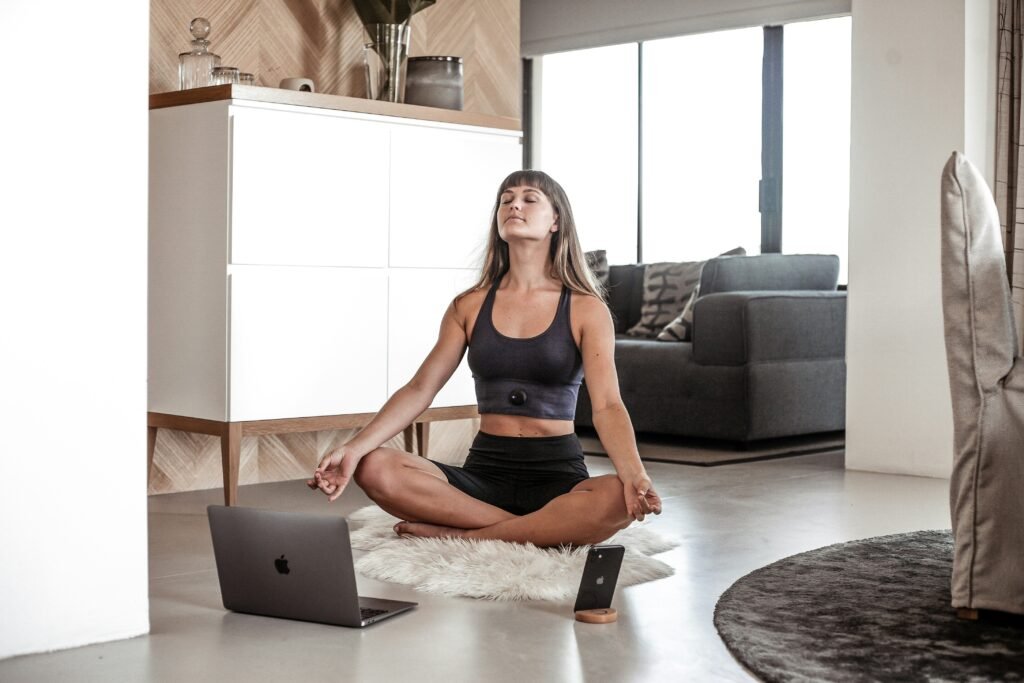
For building a low-pressure daily breathwork routine
If the meditation itself feels like too much some days, breathwork alone — just the physical mechanics, no app, no timer — can act as scaffolding underneath it.
Box breathing (four counts in, four held, four out, four held) works well before something stressful — a meeting, a difficult call. Longer exhales than inhales (say, four in, six out) signal the parasympathetic nervous system to downshift, which is a plainer way of saying: this is why the “sigh it out” advice your relatives give actually has some grounding in physiology, whether they knew that or not. Nothing mystical about it. The vagus nerve responds to the length of the exhale. That’s the whole mechanism.
You don’t need an app for this part, which, in fairness, took me a while to accept given how much time I’d spent evaluating apps in the first paragraphs above. Sometimes the tool is just counting on your fingers at a red light.
Making It Stick Beyond the First Week
Editor’s Note: The meditation industry has a vested interest in you believing you need better guidance, more features, a nicer app — because that’s the subscription model. My contrarian take, after months of testing: the app matters far less than the anchor moment you attach the habit to. A free five-minute Insight Timer session hooked to your existing coffee routine will outlast a premium Headspace subscription with no fixed trigger. Buy the habit a home before you buy it a better teacher.
How to apply this, organized by what you actually need right now:
- Mindset anchor — Stop aiming for a clear mind. Aim for noticing and returning, ten times a session if that’s what it takes.
- App selection — Headspace if you want a course to follow; Calm if the problem is nighttime racing thoughts; Insight Timer if budget or teacher variety matters most.
- Practice length — Five minutes, daily, non-negotiable, longer only on days it feels easy rather than as a rule.
- Missed-day recovery — Restart the next day without narrating a failure story about it. The habit survives gaps; it doesn’t survive guilt.
- Emergency use — Ninety seconds of slow exhales at your desk counts. It doesn’t need to be a formal sit to be useful.
This article reflects editorial testing and general wellness practice, not medical advice — if anxiety, sleep issues, or racing thoughts are significantly disrupting your life, a conversation with a doctor or therapist is a better next step than another app download.
Leave a Reply