Some nights the AC clicks off and you wake up damp at 2 AM. Other nights it never clicks off, and you wake up with a throat like sandpaper instead. Both are the same problem wearing different clothes — a bedroom that isn’t set up to help your body drop temperature the way it needs to for deep sleep. The fixes are smaller than you’d think: what’s on the bed, where the fan is pointed, how warm the water is before you lie down.
The AC Clicks Off at 2 AM and You Wake Up Damp
3:15 AM, and I’m kicking the duvet off for the third time, throat scratchy and dry, courtesy of an AC unit that’s been running since before I fell asleep. Twenty minutes later I’m cold. Then hot again. This is what a heatwave does to a bedroom that hasn’t been adjusted for it — it turns the whole night into a negotiation between two bad options.
Most people default to one of two settings during a heatwave: AC blasting all night, or AC off and a fan doing its best. Neither actually solves the problem, because the problem isn’t the air temperature. It’s what your skin is doing in response to it.
I used to think a colder room was just a colder room. It isn’t quite that simple.
Why Your Body Needs to Drop 1–2°C to Actually Sleep
Here’s the mechanism, stripped of any wellness-brand language around it: your core body temperature has to fall by roughly 1–2°C to enter and stay in deep, slow-wave sleep. This drop is part of your circadian rhythm — it starts in the evening, dips lowest in the early hours, and rises again before you wake. It’s not optional and it’s not negotiable. If your bedroom keeps that drop from happening, your body will keep pulling you out of deep sleep to try again, which is a lot of what a “restless” heatwave night actually is.
Your body manages this mostly through your skin, specifically your hands, feet, and face, which act as radiators. Blood vessels near the skin’s surface widen (vasodilation), releasing heat outward, and that release is what allows your core to cool. A bedroom that’s too hot blocks this. A bedroom that’s too dry, from AC running all night without any humidity buffer, dries out your mucous membranes and wakes you up a different way — hence the sandpaper throat.
So the goal for a summer bedroom setup for deeper sleep isn’t “colder.” It’s “cool enough, and set up to let heat leave your skin efficiently” — which, in fairness, took me a while to actually believe, because “just turn the AC down” feels like it should work and mostly doesn’t.
When the Sheets Are the Problem, Not the Weather
I didn’t touch my bedding for the first two heatwaves I lived through. Kept blaming the AC unit. It wasn’t the AC unit — it was a set of heavy cotton-poly sheets that were trapping heat against my skin all night, working directly against the temperature drop my body was trying to manage.
Fabric matters more here than most bedroom advice suggests, because fabric determines whether the heat leaving your skin actually gets to leave the bed.
Bedding Element — Spec | Circadian & Thermoregulation Mechanism
- Linen sheets, 165–200 gsm, pre-washed — loose weave, high airflow | Lets ambient air pass through the fabric instead of trapping it against skin, supporting continuous heat loss through the night
- Modal or bamboo-modal pillowcase | Moisture-wicking fiber structure pulls sweat away from the face and neck faster than cotton, reducing the “waking up damp” spike that interrupts slow-wave sleep
- Synthetic-blend fitted sheet (the one to avoid) — low breathability, heat-retentive | Traps radiant heat against the mattress surface, working against the skin’s vasodilation and slowing the core temperature drop
- Cotton percale (mid-tier option) — crisp weave, moderate airflow | Reasonable heat release but slower to dry than linen once damp, which matters most on the most humid nights
None of this needs to be expensive. A linen top sheet swapped in for July and August, even over an existing mattress setup, changes the felt temperature of the bed more than people expect.
Positioning a Fan So It Cools You Without Wrecking Your Throat
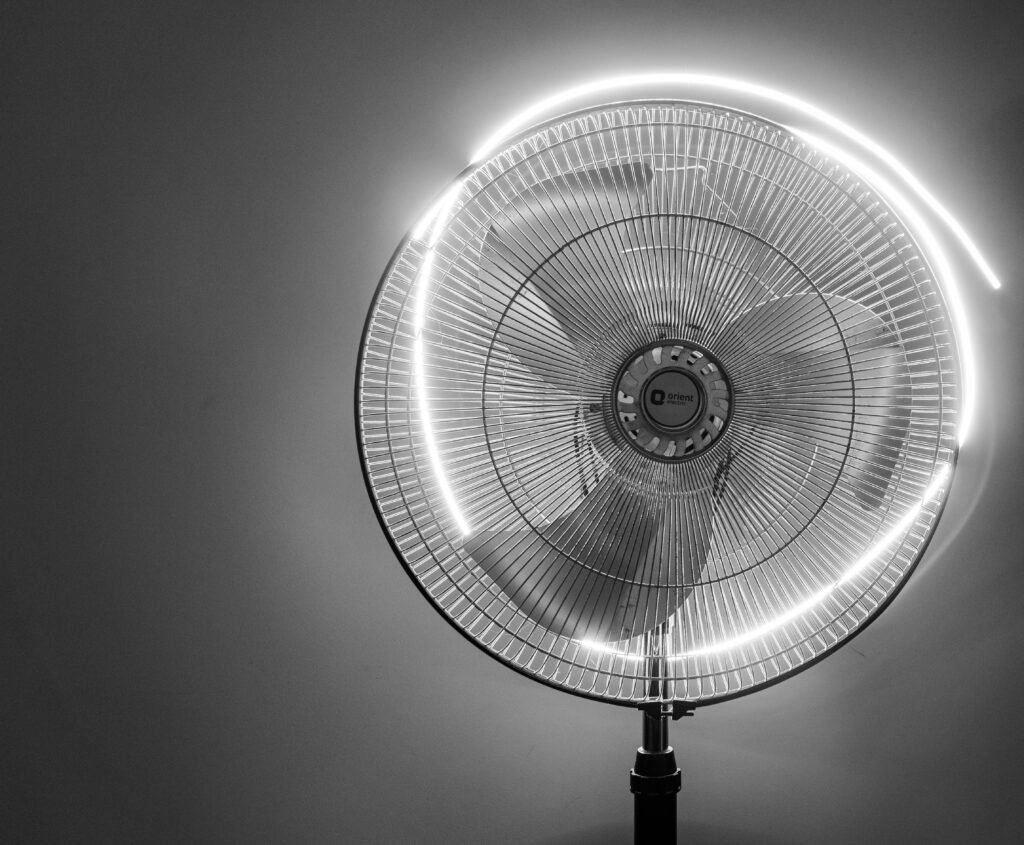
For years I pointed my fan directly at the bed, which felt logical and was, it turns out, part of what was drying out my throat. A fan aimed straight at your face for eight hours does cool you, but it also accelerates moisture loss from your skin and airway — that’s the dry-throat trade-off nobody mentions when they say “just get a fan.”
The better move, when setting indirect fan oscillation to support natural core body cooling, is to angle it toward a wall instead of your body. The air bounces, diffuses, and reaches the bed as a broader, gentler current rather than a direct blast. It’s less dramatic. It also works better, because what you actually want is ambient air movement across the room, not a jet stream on one side of your neck.
(A small, unglamorous tip: cracking the door a few inches so the fan can pull slightly cooler air from the hallway makes a bigger difference than upgrading the fan itself.)
For rooms with an AC unit running low overnight, positioning the fan to circulate that already-cooled air — rather than running the fan and AC as two separate, competing systems — tends to let you set the AC a degree or two higher without losing comfort. Lower AC output, less drying effect on your throat. That’s really the whole trick.
The Shower Temperature That Tricks Your Skin Into Cooling Down
This is the part people get backwards most often. A cold shower right before bed feels like it should help you sleep cooler, and for about ten minutes it does — but cold water causes your blood vessels to constrict, which is the opposite of what your body needs to do to release heat. You end up warmer, faster, once you’re under the covers.
A lukewarm shower, closer to skin temperature than to “refreshing,” does something more useful: it triggers peripheral vasodilation, the same widening of surface blood vessels involved in your natural pre-sleep cooling process. Warm water on skin signals the body to push blood toward the surface; once you step out and that water evaporates, heat leaves with it, and your skin genuinely runs cooler for the next hour than it would after a cold shower.
I was skeptical of this one. Tried it for about a week expecting nothing, and the sandpaper-throat mornings noticeably dropped off — not because the room got colder, but because I wasn’t fighting my own vasoconstriction on top of the heat.
Building a Bedroom That Survives Tropical Nights
Editor’s Note: I think most heatwave sleep advice is aimed at the wrong variable — it’s obsessed with degrees on a thermostat and ignores that your skin, not the air, is doing the actual work of cooling you down. Buy the linen sheet before you buy a second AC unit. It’ll do more.
A few situational adjustments, organized by what you’re actually doing at the time:
- Fabric swaps: Linen or Modal for July–August; store the heavier cotton-poly set until fall
- Fan placement: Angle toward a wall, not the bed; crack the door slightly for airflow; let it circulate AC output rather than compete with it
- Pre-bed showering: Lukewarm, not cold, roughly 20–30 minutes before lying down
- AC settings: A degree or two higher than instinct suggests, paired with better airflow, usually beats a colder, drier room
None of this requires a renovation. Most of it requires undoing habits that felt logical — colder is better, direct airflow is better, cold water is better — but were quietly working against how your body actually cools itself down for sleep.
This piece reflects general sleep physiology and isn’t a substitute for medical advice, particularly if heat is genuinely disrupting your health and not just your sleep score.
Leave a Reply