A slow walk through an autumn forest does more than clear the head — it appears to change the body’s internal chemistry. Research growing out of Japan’s Shinrin-yoku tradition suggests that airborne compounds released by trees, paired with the simple act of walking without distraction, may support the immune system’s natural defense cells for days afterward. This piece looks at the science in plain language, and at what an unhurried 40-minute walk can realistically offer before the week starts again.
The air changes first. Somewhere past the treeline, the temperature drops two or three degrees, and the ground gives off that particular autumn smell — wet bark, decomposing leaves, something faintly resinous underneath it all. Lungs seem to work a little less hard. That’s not imagination. It’s the first sign of stepping into a different chemical environment than the one most of us breathe all day.
Forest bathing — a rough translation of the Japanese shinrin-yoku — has spent the last decade drifting from wellness trend into something closer to a documented health practice. It isn’t hiking, and it isn’t exercise in the conventional sense. It’s closer to a deliberate slowing down, done specifically among trees, and Japanese researchers have spent over fifteen years trying to understand why it seems to do something measurable to the people who practice it.
The Canopy Molecule: How Airborne Phytoncides Awaken NK Cells
Trees, particularly conifers and oaks, release volatile organic compounds called phytoncides — airborne chemicals that plants produce partly as a natural defense against insects and decay. In autumn, as evergreens shift their oils and deciduous trees release compounds through decomposing leaf litter, the concentration of these aerosols in a forest tends to run higher than in a city park or a backyard.
Dr. Qing Li, a physician and researcher at Nippon Medical School, has studied this effect for years. His research found that people who spent time walking in forests showed an increase in natural killer, or NK, cell activity — a category of white blood cell involved in the body’s early response to abnormal or infected cells. In his studies, this increase in NK activity was measurable for about a week after a forest visit, and it appeared to correlate with time spent breathing forest air rather than with physical exertion alone. Some of his work also traced the effect to intracellular anti-cancer proteins within these cells, which seemed to rise alongside the NK activity itself.
None of this means a walk in the woods replaces medical care, and no credible researcher frames it that way. What the data suggests, cautiously, is that regular exposure to forest air may support the body’s baseline immune surveillance — the quiet, ongoing work these cells do before anyone gets sick.
Sensory Anchoring: The Art of Leaving the Screen in the Pocket
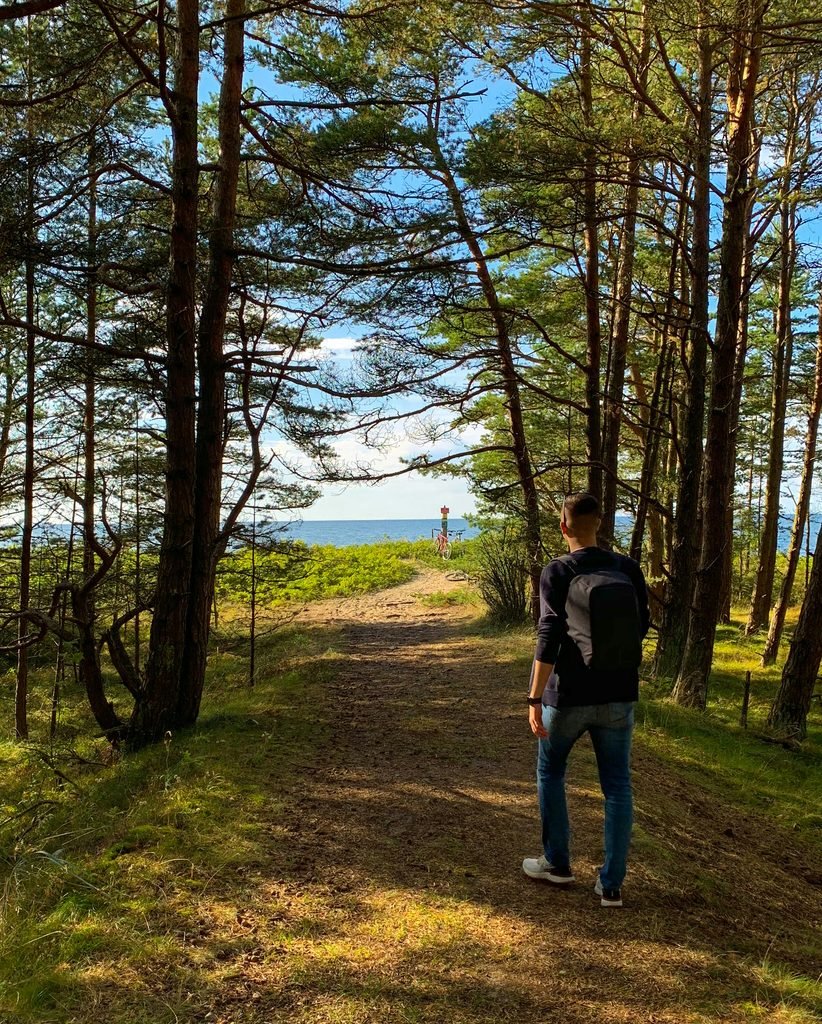
There’s a meaningful difference between power hiking — head down, pace fixed, mentally elsewhere — and the kind of walking this research is actually built around. Shinrin-yoku isn’t about covering distance. It’s about arriving nowhere in particular, slowly, while paying attention to what’s actually there.
I caught myself, about a hundred meters in, reaching for my phone to photograph the canopy — a reflex so automatic I didn’t register it until the phone was already halfway out of my pocket. I put it on airplane mode instead and kept it there. The first ten minutes of walking without that option felt strangely restless, like an itch with no obvious place to scratch. That discomfort is fairly normal and tends to fade quickly once there’s nothing left to check.
Sensory anchoring is the term some forest-therapy guides use for this kind of walking: naming the specific texture of the ground underfoot, noticing where the wind moves and where it doesn’t, letting the ambient rustle of dry leaves register instead of tuning it out. It’s a small shift, but it changes the entire quality of the walk. The forest stops being a backdrop and starts being the point.
The Nervous System’s Slow Exhale
Underneath the sensory experience, something physiological is happening. Time in a low-stimulation, high-oxygen environment appears to shift the body from a sympathetic, alert state toward a parasympathetic, rest-oriented one. Studies comparing forest walks to equivalent urban walks have reported lower circulating cortisol, the body’s primary stress hormone, along with reductions in resting heart rate and blood pressure among forest-walk participants.
This shift is often described in terms of vagal tone — a rough measure of how readily the body can move into a calm, recovered state through the vagus nerve, which helps regulate heart rate, digestion, and the stress response. Elevated vagal tone is generally associated with better stress resilience. Forest environments, with their absence of traffic noise, screens, and abrupt stimuli, seem to give the nervous system enough quiet to settle into that state more easily than most other everyday settings allow.
The 40-Minute Dose: What a Single Walk Can Realistically Offer
Most of the research on measurable effects — lowered cortisol, shifts in NK activity, changes in resting blood pressure — points to walks in the range of thirty to forty minutes, done at an unhurried pace, in an area with meaningful tree cover. That’s a specific enough window that it starts to feel achievable rather than aspirational. It doesn’t require a wilderness trip. A wooded park edge or a quiet stand of trees on the outskirts of town can be enough, provided the pace stays slow and the attention stays present.
The payoff isn’t dramatic in the moment. It’s more that Monday morning, after a Sunday walk like this, tends to feel slightly less braced — blood pressure a touch lower, the internal noise a touch quieter, some reserve of steadiness that wasn’t quite there the week before.
A Small Note on What This Isn’t
It’s worth being precise here. Forest bathing isn’t a treatment, and the research behind it doesn’t claim to cure stress or guarantee immunity from illness. What the evidence suggests is more modest and, honestly, more believable: that time spent breathing forest air and walking slowly through it may support cellular defense activity and help steady the nervous system’s baseline. That’s a meaningful thing on its own, without needing to overstate it.
Editor’s Note: I’m not a physician, and nothing here should stand in for medical advice — this is simply what the current research on forest bathing appears to show, read with a healthy amount of caution. If you’re managing a health condition, it’s worth talking to a doctor before treating a walk in the woods as part of a wellness routine.
How to apply this — a low-tech autumn woodland walk:
- Choose a wooded area with real tree cover — a forest edge, a park with mature trees, or a quiet grove works fine.
- Set aside 40 minutes, and leave the pace deliberately slow — this isn’t a workout.
- Put your phone on airplane mode before you start, not after the urge to check it passes.
- Spend the first few minutes simply naming what you notice — the smell of the ground, the temperature of the air, the sound underfoot.
- Let your eyes rest on the canopy rather than the path for a few stretches of the walk.
- Don’t force a destination. Circling the same stretch of trees slowly counts just as much as covering new ground.
Leave a Reply