I started chipping dried Chaga off a chunk the size of a fist because I didn’t own the right tool, and somewhere between the third failed attempt and the fourth, I got curious enough to actually read the research instead of the marketing copy. This is the version of that research I’d tell a friend over the counter — what Reishi, Chaga, and fermented ginseng are actually doing at the cellular level, why your gut microbiome decides half the outcome, and where fermented herbs and functional Asian botanicals for cellular renewal genuinely earn their place, versus where they’re just expensive dust.
The butter knife wasn’t the right tool. I knew that before I started, but the actual Chaga knife — the one every forum insists you need — was still in a drawer somewhere I hadn’t unpacked, and the tea wasn’t going to steep itself. So I stood at the stone cutting board, working a blunt edge into a mushroom that looked less like food and more like a piece of burnt asphalt, and thought: people have been doing something like this for over a thousand years, and I can’t even find my good knife.
That’s roughly how I came to actually understand what’s inside this stuff. Not through a study abstract first. Through the inconvenience.
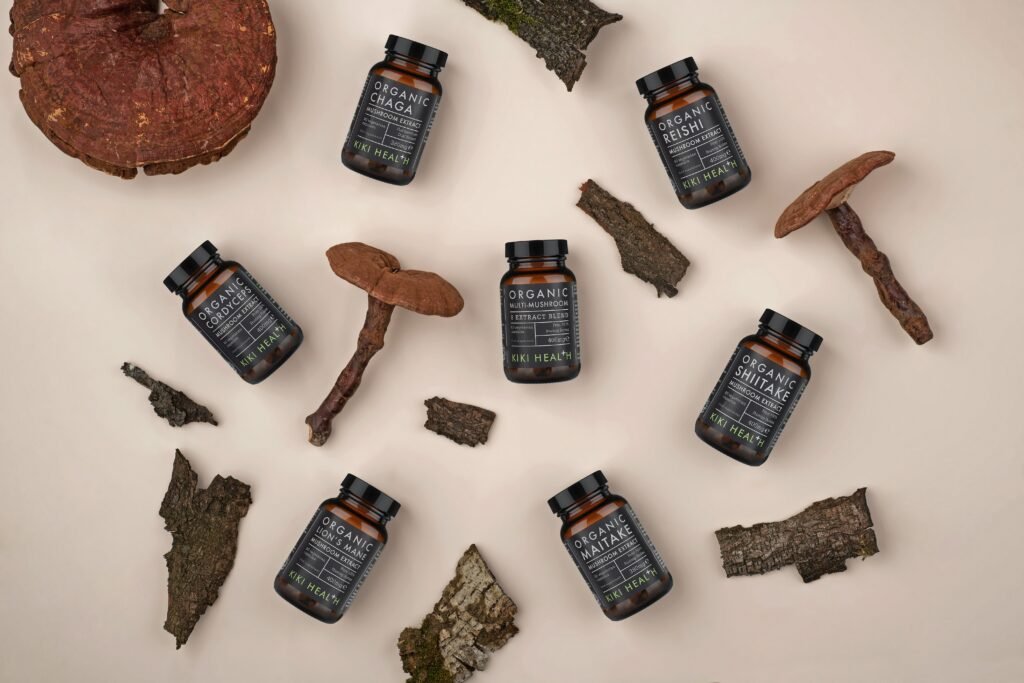
When you want cellular cleanup, not just “detox”
Autophagy is a word that gets thrown around loosely enough that it’s started to mean almost nothing — somewhere between “fasting” and “wellness.” Stripped down, it’s a maintenance process your cells run to break apart and recycle their own damaged parts: old proteins, worn-out mitochondria, debris that accumulates faster than the body clears it as you age. When that process slows, the junk piles up. When it’s triggered — by fasting, by exercise, or by specific plant compounds — cells break the debris down and reuse the raw materials.
This is where Reishi and Chaga stop being folklore and start being chemistry.
Reishi — Ganoderic Acids | Modulates mTOR signaling, one of the primary switches that suppresses autophagy when nutrient levels are high Reishi’s triterpenes, chiefly the ganoderic acids, interact with the mTOR pathway — the same pathway that fasting and calorie restriction affect. When mTOR activity drops, autophagic flux tends to increase. This doesn’t mean Reishi mimics fasting exactly (it doesn’t, and I’d be skeptical of anyone claiming it does), but the mechanistic overlap is real and well-documented in preclinical models.
Chaga — Betulinic Acid & Melanin-Bound Polyphenols | Reduces oxidative load on mitochondria while supporting mitophagy, the selective clearance of damaged mitochondria Chaga’s betulinic acid content, along with its dense polyphenol profile, appears to reduce oxidative stress at the mitochondrial level, which indirectly supports the signaling that flags damaged mitochondria for removal. The polyphenols also happen to be why the water goes the color of strong black tea within about ninety seconds of contact — which, in fairness, took me longer to trust than it should have. I assumed the color meant it was over-steeped. It wasn’t. That’s just Chaga.
I’ll admit the first cup I made was borderline undrinkable — too concentrated, bitter in a way that lingered — because I didn’t know yet that less is genuinely more here. Three grams, not ten.
For clearing out the debris before it becomes a problem
Cellular senescence is the less glamorous cousin of aging research: cells that stop dividing but refuse to die, instead sitting there releasing inflammatory signals that affect the tissue around them. Clearing senescent cells, or at least reducing the inflammatory noise they generate, is a separate but related goal from triggering autophagy — and this is where fermented ginseng earns its distinct spot on the shelf, rather than just being “ginseng, but fancier.”
Fermented Ginseng — Compound K, Ginsenoside Rg3, and Free Polyamines | Improved bioavailability driving mitophagy activation and senescence-associated inflammatory reduction Raw ginseng contains ginsenosides in forms the body absorbs inconsistently — some estimates put unmodified ginsenoside bioavailability under 5%. Fermentation, typically with specific bacterial or fungal cultures, converts those large-sugar-bound ginsenosides into smaller, more bioactive forms like Compound K and Rg3. This is genuinely a case where the traditional processing step (fermentation) turns out to be the mechanism, not just a flavor or preservation choice, which I didn’t expect going in.
Fermentation also produces free polyamines as a byproduct — and polyamines, particularly spermidine, are one of the more consistently studied autophagy triggers in current longevity research.
(I keep a jar of fermented red ginseng paste in the fridge door, next to the mustard, which feels like an undignified place for something with this much research behind it. It’s still where it lives.)
When your gut has to finish the job the plant started
Here’s the part that gets left out of most write-ups, and it’s arguably the most important mechanism in the whole conversation: many of these compounds aren’t directly active as consumed. They require conversion — by your gut microbiome — before they do anything at all.
Ellagitannins, found in pomegranate, walnuts, and some fermented herbal preparations, are inert until specific gut bacteria — largely from the Gordonibacter and related genera — metabolize them into Urolithin A. Urolithin A is the compound with the more compelling mitophagy research; the ellagitannins themselves are essentially the raw material, not the active ingredient. Which means two people eating identical amounts can get meaningfully different outcomes depending on their microbiome composition. Somewhere between 30–40% of people, depending on the study, are considered low or non-producers.
That statistic changed how I think about all of this. It’s not “eat X, get Y.” It’s “eat X, and depending on who’s living in your gut, you may or may not get Y” — which is a much less marketable sentence, but a more honest one.
Spermidine follows a related, though not identical, path: dietary spermidine from fermented soy products, aged cheese, and wheat germ is absorbed directly in the small intestine, but gut bacteria also produce additional spermidine as a metabolic byproduct, meaning microbiome health influences total systemic spermidine levels independent of diet alone.
Fermented Soy (Natto, Doenjang) — Spermidine & Polyamine Precursors | Direct intestinal absorption plus microbiome-driven endogenous synthesis This is the category most people already have some access to, culturally, without realizing its relevance. Natto in particular carries a notably high spermidine concentration relative to volume consumed.
For days when convenience wins and the ritual doesn’t happen
I’d be misrepresenting this if I made it sound like I do all of this daily, because I don’t. There are stretches — a bad week, travel, a kid with a fever — where the Chaga sits untouched for ten days and I don’t think about ganoderic acids once. That’s fine. None of this is a compound single dose; the research behind autophagy triggers assumes sustained, moderate exposure over time, not a perfect unbroken streak.
What I’ve settled into isn’t a schedule so much as a set of defaults: Reishi tea most evenings, not because of ritual but because it’s mild enough to drink late without regretting it. Fermented ginseng paste stirred into warm water maybe three or four mornings a week. Natto genuinely never — I’ve tried, the texture defeats me every time, so I lean on tempeh instead, which carries a smaller but still present spermidine load.
What Actually Stays in My Cupboard
Editor’s Note: I think the wellness industry has done real damage to how people understand these botanicals by flattening Reishi, Chaga, and fermented ginseng into one interchangeable “adaptogen” category. They’re not interchangeable. They hit different mechanisms — mTOR modulation, mitochondrial oxidative protection, bioavailability conversion — and treating them as a single vague wellness gesture is exactly how you end up with an expensive cupboard and no idea what any of it is doing.
How to actually apply this:
- For triggering mitophagy and clearing damaged mitochondria: Chaga, brewed weak (3g, not a heaping spoonful), and given time — this is not a same-day-results compound.
- For improving ginsenoside and polyamine bioavailability: fermented ginseng specifically, not raw root; check that fermentation is stated on the label, because plenty of “ginseng” products skip that step entirely.
- For supporting Urolithin A conversion: pair ellagitannin sources (pomegranate, walnuts) with general gut health basics — fiber diversity, fermented foods — since conversion capacity depends on your microbiome, not just intake.
- For dietary spermidine without relying on gut conversion: fermented soy, aged cheese, wheat germ, added consistently rather than in one large dose.
- For evenings when you want something mild: Reishi tea, which is gentle enough to not interfere with sleep, unlike some of the more stimulating adaptogen category.
This article reflects current preclinical and early-stage research on autophagy, mitophagy, and polyamine metabolism; it is not medical advice, and none of these botanicals are a substitute for treatment of any diagnosed condition — talk to a doctor before adding concentrated mushroom or fermented herbal extracts if you’re on medication, particularly anything affecting blood clotting or immune function.
Leave a Reply